 DE

A systematic approach to laboratory work: Why the TriMax is a good fit for the pharmaceutical industry
In pharmaceutical laboratories, precision determines quality: every step in the process must be reproducible and fully documented. At the same time, projects, procedures and teams are constantly changing. We explain why the TriMax workstation system offers the ideal conditions for this.
Quality & Documentation: What really matters in the pharmaceutical industry
In the pharmaceutical industry, precision is key. For this reason, the manufacture of medicines and active pharmaceutical ingredients must comply with Good Manufacturing Practice (GMP). These are guidelines for quality assurance in production processes and the production environment, designed to ensure that no quality deviations occur. Processes must be designed from the outset to prevent errors from occurring in the first place, rather than sorting out faulty products at the end of the process.
GMP therefore requires comprehensive documentation in accordance with the principle that ‘what is not documented is deemed not to have been done’. All steps, batches and deviations must be meticulously recorded. Every product must also be traceable retrospectively – from raw materials right through to machinery and staff. Process standardisation plays a major role in deviation management. Work steps must be precisely defined and reproducible. Deviations – whether unplanned or authorised – are clearly documented.
The working environment is also a key aspect of GMP. Laboratory equipment must be fit for purpose and operate reliably. Laboratories therefore rely on high-tech workstation systems that meet the stringent requirements of the pharmaceutical industry. One such system is TriMax by KARL.
TriMax in the pharmaceutical industry
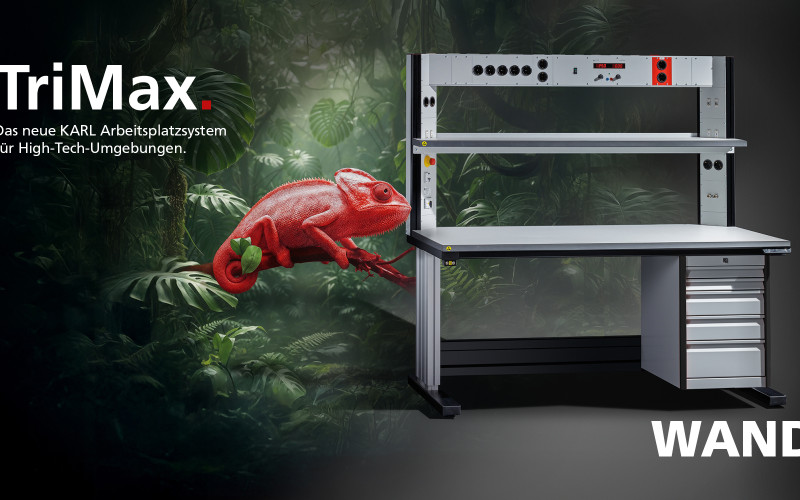
TriMax has been developed for professionals who carry out and document their work with a high degree of precision – in electronics manufacturing, the defence sector or pharmaceutical laboratories. With its modular design, TriMax provides the ideal conditions for standardised processes and straightforward documentation.
Standardised components, fixed table dimensions and tables that can be linked in sync ensure that workstations in pharmaceutical production are set up according to the same pattern. Staff can move between workstations as required, whilst always encountering the same conditions and procedures. Should projects or processes change, the modular workstations can be easily reconfigured.
The Comfort and Premium variants, in particular, make documentation easier: data interfaces, mounts for monitors or tablets, and integrated systems for recording work and testing processes are all located right at the workstation.

Pipetting and microscopy: a major strain on the neck
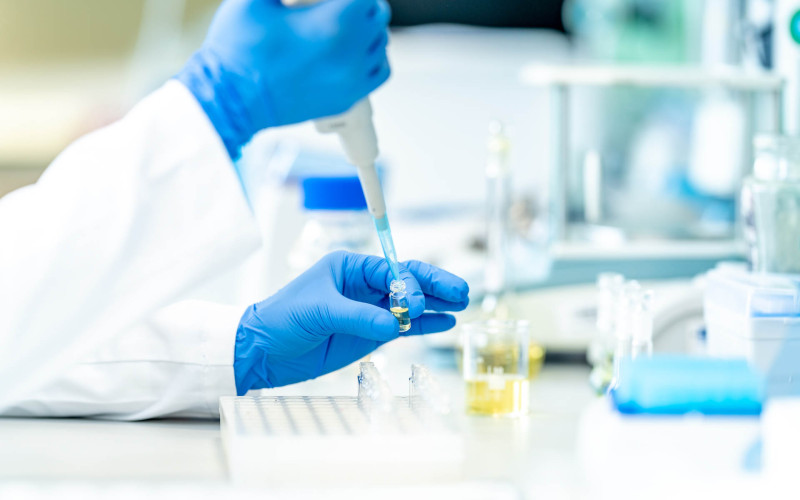
Pipetting, microscopy and computer work: routine tasks form part of everyday life in pharmaceutical laboratories. According to the US Occupational Safety and Health Administration (OSHA), it is precisely these repetitive tasks that place a high physical strain on staff. Without ergonomic measures, they are at risk of strain injuries, particularly in the neck area.
When pipetting and using a microscope, the upper body leans over the table. If the table is set at the correct height, staff are better protected against health risks. However, this height varies from person to person – as do the optimal reach distances for containers and documentation points.
In the laboratory, desks are needed that can be adapted to different users. A suitable workstation system is therefore height-adjustable. TriMax can be adjusted continuously at the touch of a button. Depending on the model, three to four settings can be saved – this is important in shift work when several people use the same workstation. Thanks to its modular design, you can also adjust the reach.
This is how the TriMax is used in the laboratory
Projects, methods and teams may change, but the requirements for precision in production and documentation remain the same. The overview highlights the typical challenges that TriMax addresses in pharmaceutical laboratories.
| Challenges in the laboratory | How TriMax helps |
| New procedures | Tool-free changeover |
| Rotating staff on shift work | Saved elevation profiles |
| Extensive pipetting and microscopy work | Adjust the working height and reach |
| Comprehensive documentation | Data interfaces and data capture systems |
| Plenty of equipment on site | Modular power and data strips |
| Growing teams | Combining tables and controlling them in synchronisation |
Ready for a change in your laboratory?
More interesting facts
A systematic approach to laboratory work: Why the TriMax is a good fit for the pharmaceutical industry
In pharmaceutical laboratories, precision determines quality: every step in the process must be reproducible and fully documented. At the same time, projects, procedures and teams are constantly changing. We explain…
How the workplace system in the defence sector remains flexible
The defence industry is expected to deliver faster than ever before, yet no one knows how long demand will remain high. What is needed is a manufacturing process that can…

The dangers of electrostatic discharge (ESD)
A tiny spark with major consequences: electrostatic discharges can damage or completely destroy electronic components – sometimes without anyone even noticing. In this article, you’ll find out what risks ESD…

The Chameleon TriMax: A look at its versatility
Production processes are changing – and with them, the demands placed on the workplace. The Chamäleon TriMax is designed to keep pace with this change: it is flexible, ergonomic and…